The South Carolina Early Learning Standards are incorporated into the Sunflower classroom curriculum.
Standards addressed in this post include:
- Goal ESD-3: Children form relationships and interact positively with familiar adults who are consistent and responsive to their needs.
- Goal ESD-4: Children form relationships and interact positively with other children.
- Goal ESD-6: Children identify, manage, and express their feelings.
- Goal ESD-7: Children recognize and respond to the needs and feelings of others
Early Childhood education has an essential focus on social-emotional development that helps children grow into emotionally intelligent and successful individuals. In the Sunflower classroom, the three-year-old class, we pay special attention to forming and sustaining peer to peer relationships and teacher to student relationships (ESD-3, ESD-4). To foster these relationships, we model and practice how to identify, manage, and express feelings and recognize and respond to others’ feelings (ESD-6, ESD-7)
Building Relationships Through the Computer
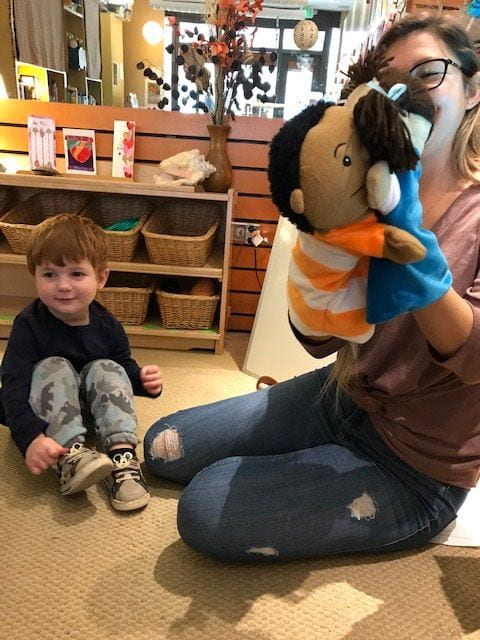
This year started with many changes, hurdles, and opportunities for growth as we tackled school during a time of social distancing. We began our school year virtually for the first three weeks. We soon learned that we had to adapt our typical in-person teaching style into a format where building relationships on an online platform was the priority. Young students learn through play rather than the direct instruction that online learning invites. We began doing small group “virtual playdates,” where a group of one or two students would engage in cooperative play and interact freely, trying to mimic a small group setting in a real classroom. Examples of this include playing with playdough or painting. Students began to increasingly interact and build relationships with the teachers and other students as the play continued over the first three weeks.


To encourage the formation of relationships with their classmates, we thought that it was important for the children to get used to seeing each other’s faces and learning each other’s names (ESD-4). We created the book Sunflowers, Sunflowers, Who Do You See? To help the students become familiar with all of their classmates.

Emotional Expression While Mask-Wearing
As we returned to the classroom, the students were excited to see their peers and to continue building the relationships that they had made during the online instruction period. To begin the year in person, we began to discuss the different feelings that we have. This topic was introduced during circle time through picture books, games, and discussions. We read many stories, such as The Way I Feel, that showed images of different facial expressions and body language. One obstacle that we encountered was the difficulty of teaching children how to recognize others’ feelings when only their eyes are visible (ESD-7). We adapted to this new challenge by focusing on the eyes and what the rest of the body was saying. After practicing and discussing how we can identify others’ emotions while wearing masks, we asked the students how you can tell if someone is angry. Their answers included:
“Their eyebrows”
“Grumpy faces”
“When they stomp their feet”
“They are grumpy when they cross their arms.”
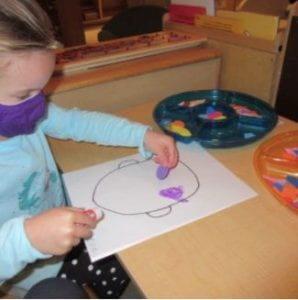
The class exploration of facial expressions and recognizing their peers’ feelings was extended into class centers and small group activities. Students used magnetic facial features to create different emotions and used shapes and glue to create facial features.

Creating Relationships on the Playground
At the start of the year, the children took their masks off for outdoor play. While relationships were slower to evolve in the classroom with masks, everyone was coming out of their shell outside. This observation showed us that young children benefit from seeing the entire facial expression of their peers. We continued to encourage the students to study their peers’ faces when there was conflict, and the students were mask-free. Without the added barrier of a mask, the students could identify how their friend was feeling more accurately (ESD-7). As cases began to rise and temperatures began to lower, we had the students wear masks outside as well. We were pleasantly surprised that since the strong relational bonds already had a foundation, the added mask-wearing did not impact the growing relationships. Students continued to collaborate in play with their peers and ask the teacher for assistance when needed (ESD-3).


A Fun-filled Semester
Although this year has brought many challenges with the addition of mask wearing, social distancing, and plexiglass, our students have continued to develop social emotional skills. We have collected notes throughout the semester on their interactions, and here are some examples:
“Would you like to play with me?”
“Let me go get you some help”
“I want to be alone right now”
“They are my best friends!”
“Come over here and let’s build this thing!”
In our class, the students have developed close bonds, positive relationships, and conflict resolution skills.




 rolled out and decorated sugar cookies with a variety of cookie cutter shapes and sprinkles that allowed everyone to use their creativity. The Sunflowers also baked fresh loaves of bread from scratched and shared their hard work with their school community. Activities such as this help the students recognize that they are members of different groups (Goal CD-7) and encourages helpful community habits. The Sunflowers continue to add their creativity and cheer to the ECDC hallways!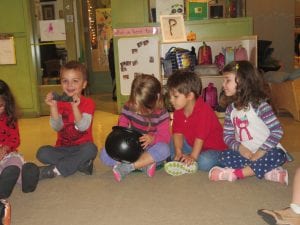

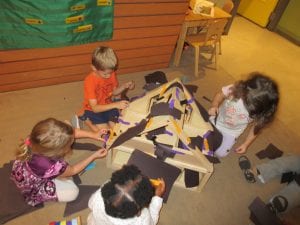
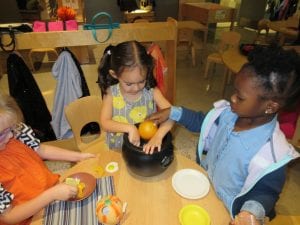 , acting out entire sequences with defined characters and plots. We are able to practice our problem solving skills (Goal APL-6) when the story isn’t quite working out as planned. Some students offer to be ghosts or other monsters to keep the game active and complex. The kitchen has turned into a place for witches to make brew and the art center is filled with tricks and treats to make spooky creations.


